
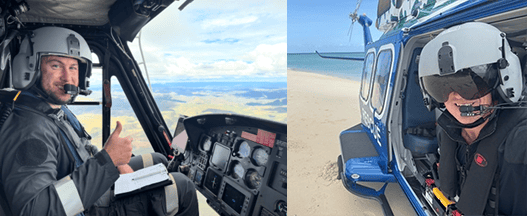
Former Rescue Crew Officers Matt O’Brien and Sam McLean have recently been promoted to the role of Aircrew Officer. Both found their way to the world of helicopter emergency medical services after seeing it up close.
Matt O’Brien and Sam McLean have come to the job from very different directions. Matt spent most of his working life in the mines, where Sam spent nine years in the police. What they share is the moment that pulled them toward a rescue helicopter, and the work they have put in to be promoted from Rescue Crew Officer (RCO) to Aircrew Officer (ACO) on the CapRescue contract in Rockhampton.
For Matt, the moment was personal. Years ago, working as a Production Superintendent at a mine in the NSW Hunter Valley, he was out fishing when his boat capsized around 80 kilometres from shore. He set off his EPIRB (Emergency Position-Indicating Radio Beacon), and the Westpac helicopter came to his rescue.
“I went back to work at the mine but kept thinking about the rescue. Finally, maybe six or eight months later, I realised I wanted to do that for a job. I wanted to help save people’s lives like they saved mine,” he said.
It was not a quick switch. Matt needed to work on his fitness and swimming and said it took him about two years to get to the point where he could pass the fitness test. He worked offshore out of East Timor and Darwin before joining Babcock at Horn Island as an RCO, before moving to Rockhampton earlier this year.
Sam came at it from another pathway. Across nine years policing around Yeppoon, he repeatedly turned up to jobs where the rescue helicopter was deployed, including a person winched off a hillside that crews could not reach on foot, and a man stranded on a sandbank at risk of drowning.
“I saw a few people getting winched out, and I realised I wanted to be on that side of the rescue,” he said. He put the feelers out, went and got his qualifications, and joined Babcock two years ago this month.
The step up to ACO is a big one. Where the RCO does the technical end of a rescue, going down the winch wire to reach the patient, the ACO helps run the aircraft from the front left seat, conning the pilot into position, working the radios and the winch and making sure every check is done.
Both point to the same things when asked what makes the work great: the team, and the variety. No two days look alike. “It could be searches one day, the next day you’re landing on a highway, and then you’ve got your hospital transfers,” Sam said. “There’s always something different.”
Matt, who has settled into Rockhampton with a running group and Saturday morning ocean swims, says the camaraderie is one of the best elements. “It’s a really strong team vibe – everyone works together really well and looks out for each other. I also love being out in the community every day, getting to support people. It’s a fantastic job, and I’m grateful for all the support Babcock and my colleagues and supervisors have given me.”
Their supervisor, Matt Dobson, said the promotion was a credit to both men and to the investment behind them, “Our leaders have always strongly supported investment in developing our people and it’s terrific to see it paying off. We are creating a promotional pathway that recognises consistent high performance and fosters employee satisfaction.”
Hear from Matt, as he explains the key differences between the ACO and RCO career pathways and reflects on what makes the work so rewarding: