
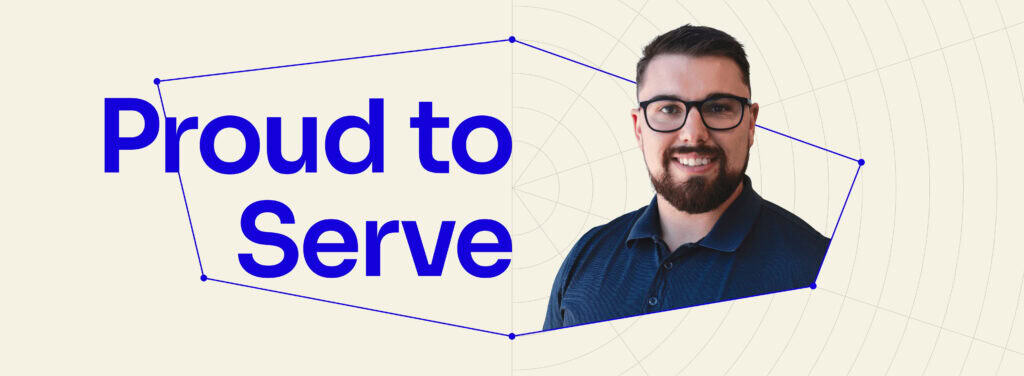
Damian is Project Management Team Lead for the C-CBRNE Program and finds pride in having a direct positive impact on supporting the ADF. He is a proud veteran, driven to provide the best quality outcomes in a rapidly changing environment.
Damian served in the Australian Army for 8 years as an Advanced Electronics Systems technician, specialising in Armoured Vehicle Platforms and leading a small team of multidisciplinary soldier tradesmen.
He joined Babcock in 2022 and has forged a career path in our Counter – Chemical, Biological, Radiological, Nuclear and Explosive (C-CBRNE) Program.
We caught up with Damian to chat about his career at Babcock, and the pathway he followed transitioning from Defence to civilian employment.
What is your role at Babcock? Tell us a bit about what that involves.
I am the Project Management Team Lead for the C-CBRNE Program. The program supports Defence to manage existing and acquire new C-CBRNE capabilities across the entire asset life cycle, including equipment acquisitions, engineering investigations, maintenance and repairs. Babcock also supports Defence to identify new C-CBRNE technologies, as well as delivery into service, training and through-life support. We currently manage 132 different types of equipment.
As Project Management Team Lead, I oversee projects that put new and emerging capabilities into the hands of the soldiers, while also managing the modification, remediation and upgrades of current in-service fleets.
I have enjoyed the added responsibility of being Team Lead, working to identify and correct workflows, policies and procedures to remediate efficiency shortfalls.
I enjoy participating in cross-functional teams within the C-CBRNE Program initiative, where collaboration and innovation are central to how we deliver outcomes. We also partner with a number of Australian small and medium-sized enterprises. You can read about one of the partnerships here: Cool, calm and connected: Easy-going relationship pays dividends for Babcock and EPE.
What is your favourite part of your current role?
I like that what we do matters. It has a direct positive effect and impact on supporting the ADF. I find I contribute more now to Defence than I did while in uniform.
A highlight for our team was seeing the C-CBRNE Program awarded Defence Connect’s 2025 Land Program of the Year at the Australian Defence Industry Awards – recognition not only from within the business that what we do matters, but also from the wider industry.
How has Babcock supported your development?
Babcock has provided me the tools to grow. Exposure and opportunity to take on challenges has helped me thrive in a world not constrained by regimental structure and order.
I have also become a mentor in the Babcock Early Careers Program which actively shapes the next generation of Project Mangers in the Defence industry. I enjoy guiding and supporting emerging project managers in their professional development and contributing to the growth of future talent within Babcock.
How is work/life balance supported at Babcock?
Babcock’s work life balance has been incredible. As a program that focuses on output, we are afforded the privilege to manage some of those things in life that can sometimes be hard to coordinate with work commitments – like picking kids up from school or attending an appointment.
What have you found to be transferrable skills from your service to your current role?
The knowledge and experience for Defence processes and niche approaches I gained from my time serving has set me up to make informed decision for how we best deliver the capabilities. Also, small things like structure and multi discipline team management.
What aspects of your transition from Defence to civilian employment were easier than expected, and what challenges did you encounter?
Transition to civilian employment is influenced by the support around you. I personally was lucky enough to work for two companies that understood the challenges of the transition to civilian life and afforded me the time to do it right.
Some aspects that were easier than expected were the separation of work from life and not having your job be your identity. A difficulty was the change in workplace culture and lack of regimental structure that military service had instilled (and was almost comforting looking back.)
Do you have any tips for current serving members or veterans who are thinking about a career change?
Defence is a fantastic pathway, but doing what is right for yourself and your family is always the priority. Change can be daunting, but allowing the right company to bridge your life from Defence to civilian can help with the transition. Your experiences and soft skills can take you further than you would ever realise and that should bring you comfort in taking a step in your next direction.